Separation anxiety can be overwhelming, but asking the right questions can help you and your dog make progress together.
These 8 questions will guide you toward a calmer, happier pup, and a more peaceful home life.
Separation anxiety in dogs can be challenging, affecting not only your dog’s happiness but also your daily life.
💔 If your dog becomes distressed when left alone, barking, whining, or becoming destructive, you’re not alone. Many dog owners face this issue, and it can be heartbreaking to see your pet struggle.
It's that time of year (for most of us). The summer holidays are coming to an end and we're back to the grindstone. Our dogs, meanwhile, have gotten used to having us around 24/7 and are now faced with home alone time…and some of them might be struggling with this.
Here are some tips to help your furry friend adjust
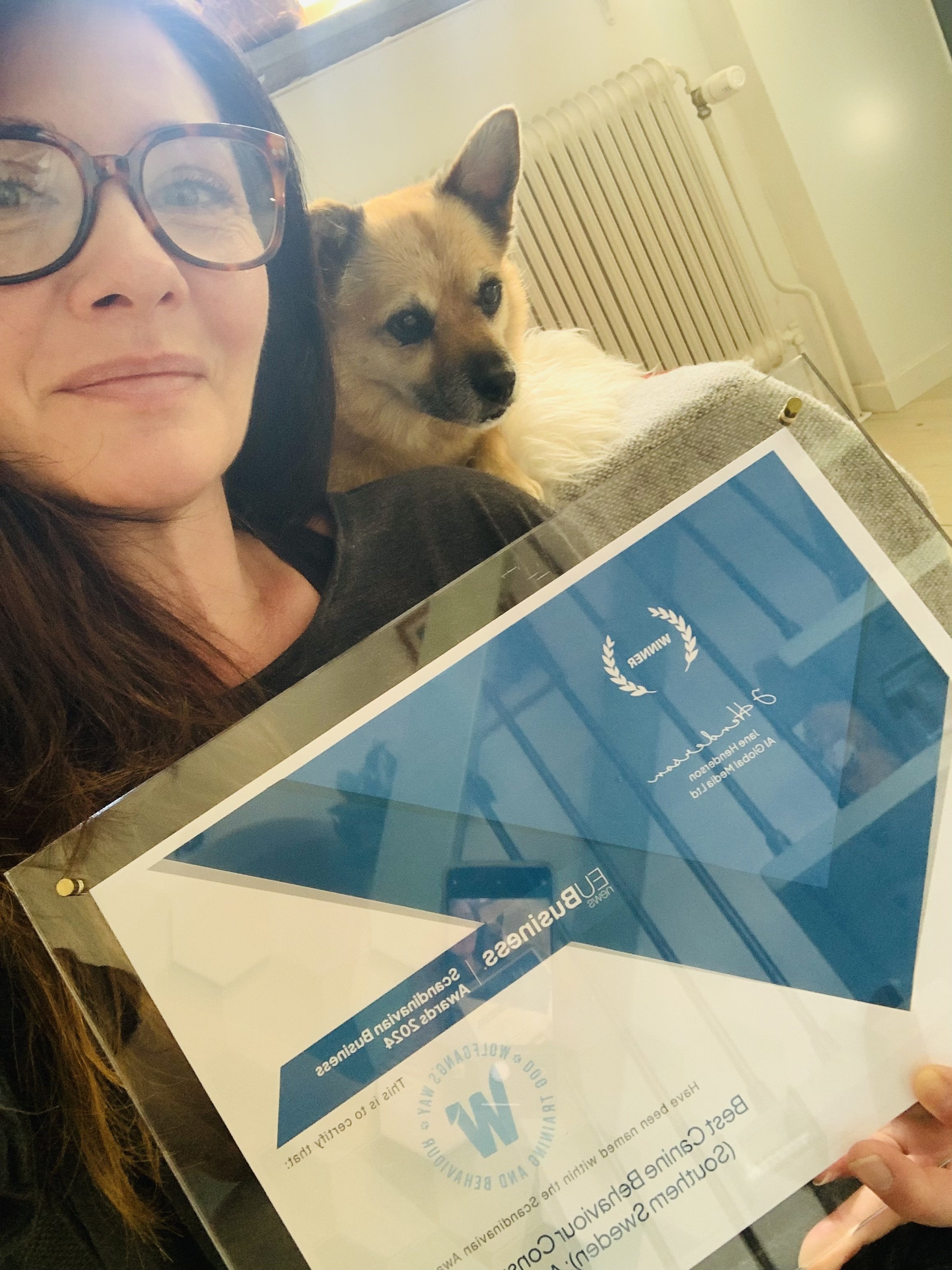
Very excited to announce that we have won another Award 🎉🎉🎉🎉
🐾 'Best Canine Behaviour Consultant 2024 (Southern Sweden)' at the Scandinavian Business Awards.
🙏 A massive thanks to all my wonderful clients who’ve taken the time and have left me great testimonials which hugely impacted on the judging panel’s decision.
🐕 And the biggest thanks to the one and only, Miss Wolfgang. This one is yours my little golden nugget ❤️
How to create a good dog training environment:
🐾 To begin with, train in a non-distracting environment to help your dog stay focused, then generalise the behaviours to more distracting environments.
🐾 Train when your dog is motivated.
🐾 Break behaviours down into small easy to learn steps.
🐾 Always allow your dog to opt out of the training when needed. For example, you may find your dog starts to sniff the floor suddenly, that’s her asking for a break.
🐾 Minimise opportunities for your dog to choose an incorrect response, providing you with repeated opportunities to positively reinforce all of your dog’s correct responses (mark & treat).
THIS WAY..for when you need to direct your dog in a general direction but don’t need them to come to you.
I use this verbal cue when the dog is off-lead to let her know “to come in my general direction” as well as for on-lead, as an ‘emergency exit’ behaviour to quickly get out of a potentially tricky situation.

Working with adolescent dogs is a wonderful, and also often challenging, training category on its own!
The key to the kingdom is to help the human understand what their dog can and cannot offer at this developmental stage.
Patience and managing the dog’s environment is a large part of it, while continuing to reinforce the right behaviours and provide outlets for what your dog needs during this tumultuous time (we’ve all been there after all, I know I have…..sorry Mum…).
If you need help with your teenage dog, I offer an ‘adolescent dog survival’ training programme to help you and your dog navigate this developmental stage.
Leash Walking Tips - whether you are starting from scratch with a puppy, working with a bouncy adolescent or adult dog or even a rescue dog who’s not used to a leash.
🐕🦺 Good equipment is key: I’d opt for a well-fitting harness but there are, as always, exceptions to the rule. Get a long leash and/ or a training line (3m - 5m, depending on your long leash handling skills).
👩🏻 Understand that you, the human, are a bit boring when it comes to walking. You walk in straight lines, probably a bit too slow or fast (depends on how your dog sees the world), you never stop to sniff or wee. Look at it from your dog’s perspective and allow for all the sniffs and exploration they need.
🌭Get your dog used to good things happening when moving with you (NOT by your side but moving with you). You can use pattern games for this, capturing (mark/ reward) check-ins and more.
🐾 When outside; start practicing in an area where your dog has the option to move more freely.
🩺 Don’t forget that underlying medial issues can feed into leash walking behaviours.

Everything starts with and is influenced by learning to ‘talk dog’ and understanding your dog’s needs (both physically and emotionally).
Good quality socialisation and habituation, working at your dog’s pace, is so much more important than teaching traditional behaviours such as sit, down, etc.
On that note, a ‘sit’ isn’t as important as you think it is. And can matter of fact become an aversive for a dog with physical ailments. Don’t make it a default part of other behaviours you teach your dog.
Be your dog’s safe place and provide as much choice and agency as you can for your dog.
A happy tummy and gut makes for a happy dog!
Be more dog, you fur friend will love you for it.
In dog training we often use the technique of luring to teach a new behaviour.
🤓 Luring meaning: guiding a dog into a desired position by holding a food treat in front of their noses. Then transitioning the luring hand motion into a hand signal, and finally adding a verbal cue. And luring is a great technique, after all we all get lured every day by tempting marketing offers around us. And it works!
But if you are after a little dog training shortcut, you can simply capture behaviours you like your dog to repeat.

Nope, it doesn’t.
There’s zero evidence.
BUT…
if your dog is hyper-attached to you, being around you 24/7 isn’t helping them to develop the coping skills for being home alone, eventually.
HOLD YOUR HORSES…
do not go crazy now and banish your anxious dog from your bedroom tonight. Everything has to be done gradually and gently.
If you need help, we are here xx

Well…firstly, you can never have enough dogs, obviously….in my opinion.
But on a more serious note; it depends, of course, but usually it actually won’t help and here are a couple of things to consider:
Your dog’s anxiety comes from being separated from you, the human, not just from being home alone. So while another dog might make your dog less lonely, it’s not likely to cure your dog’s anxiety when you’re away.
Also your current dog’s anxiety when you are not around may rub off on your second dog and then you have a double-trouble kind of situation.
So, I’m definitely all for getting a second, third, fourth dog, but do it for the right reasons, prepare yourself accordingly and enjoy your furry family.
Most dogs find it intimidating when you suddenly reach for them to grab their collar or harness and can become mouthy to keep your hands away from them or shy away from your reach.
Hence it’s important to teach them that this can be a positive experience, so you can then use it in potentially stressful situations.
The most likely explanation might just be that you were much more careful about leaving your puppy alone in the car, than about leaving them at home.
You’ve probably started with quickly getting petrol, while your pup waited for you in the car. With you in view, just a few moments, all felt safe for your little friend. Then a quick dash into a shop here and there, leaving it a little longer every time.
So they’ve gradually got used to being in the car on their own. And there have never been any scary absences.
It’s a predictable and therefore a safe routine for them.
And here’s the great news; if your dog got used to being alone in the car via using the method of gradual exposure, the same method we are using to get them to be ok with being home alone, they can also learn just that 💪❤️🐕
We accept Klarna payment